News

CFP: 2014 Goethe Yearbook

CFP for a Special Section of the 2014 Goethe YearbookGoethe and EnvironmentalismGuest Editors: Dalia Nassar and Luke Fischer

Over the past few decades, new movements have emerged in literary studies and philosophy (ecocriticism, ecopoetics, environmental philosophy etc.) that are concerned with the relationship between humanity and the natural environment, and the cultural dimension of the environmental crisis. While much attention has been given to the environmental legacy of romanticism, only a small amount of scholarship has focused on Goethe. In light of the central significance of nature in Goethe’s literary, theoretical and scientific texts, it could be argued that Goethe was a major forerunner of the environmental movement and that his ideas continue to be relevant in the present context. The aim of this special section of the Goethe Yearbook is to bring together various perspectives on Goethe’s relevance for environmental thought and, more specifically, to shed light on the environmental significance of Goethe’s legacy and on the potential of his ideas to contribute to contemporary debates in the environmental humanities. We welcome the submission of articles on Goethe’s significance for the following topics:

  • Environmental aesthetics
  • Ecocriticism
  • Ecopoetics
  • Environmental philosophy
  • Environmental ethics
  • Environmental management
  • Goethe’s legacy in the environmental movement
  • Environmental activism

Submission deadline: March 31, 2014Please send submissions to the guest editors at: dalia.nassar@sydney.edu.au and lukefisch@gmail.com.Please note that, in addition to this special section, we will continue to publish contributions on all aspects of Goethezeit literature and culture in the next yearbook. We hope to hear from many of you and particularly welcome contributions by younger scholars.

Adrian DaubStanford University

Elisabeth KrimmerUniversity of California at Davis
2014 Atkins Goethe Conference

Imagining Worlds: Aesthetics and its Institutions in the Age of GoetheUniversity of Pittsburgh, 23-26 October 2014

The Goethe Society is delighted to announce the 2014 Atkins Goethe Conference, to be held in Pittsburgh next year.

Learn more about the conference.We are soliciting papers of 20 minutes, as well as proposals for panels, that address the wide range of cultural, scientific, philosophical, and socio-political practices during the Age of Goethe that imagined and constructed meaningful worlds. The goal of the program is to consider the various ways that Goethe and his contemporaries understood and used aesthetic categories across the range of disciplines, as well as the impact of their work on aesthetic theoreticians and practitioners from the 19th through 21st centuries. We want to organize sessions that consider not only the nature of art, but also the theoretical and institutional roles of art and aesthetics in the construction of nature and science, self and society, culture and politics, etc. Papers/panels might address:

  • Topics in the fine arts (music and opera; dance; theater; painting, drawing, and sculpture; architecture; gardens) or decorative arts
  • Art as a literary motif
  • The aesthetics of genre in Goethe and his contemporaries
  • Aesthetic self-fashioning and aesthetic education in Weimar
  • The role of oppositional aesthetic categories in constructing social and political spaces (the beautiful vs. the sublime, the ugly, or the grotesque; harmony vs. carnival or chaos; purity vs. corruption or pollution; etc.)
  • Critiques of aesthetic categories and institutions from the 18th-21st centuries
  • Nature and Art: continuities and discontinuities
  • Cultural institutions (collecting; collected works; museums; schools; libraries; the theater; reading; salons; publishing; etc.)
  • Aesthetic sociality (Geselligkeit): conversation and epistolary correspondence
  • Festivities as socio-aesthetic form
  • Representation (image; metaphor; symbol and allegory; representing affect), including representations of Goethe in art from the 18th century to the present

To be considered, please submit a proposal (250 words) by 1 April 2014.

Direct any inquiries to Clark Muenzer.

2012 Essay Prize

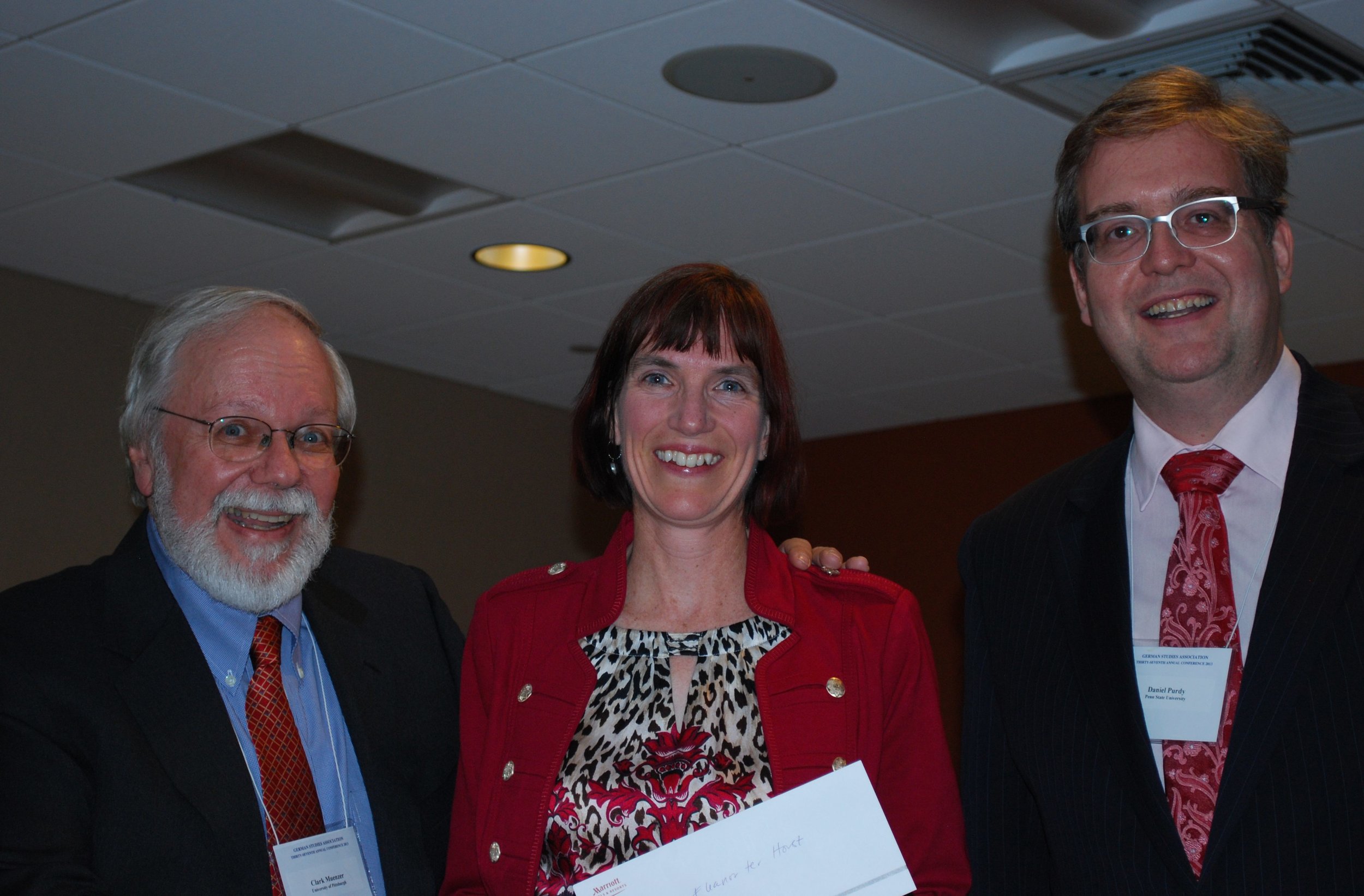
terhorstCongratulations to Eleanor ter Horst on her award-winning article, "Masks and Metamorphoses: The Transformation of Classical Tradition in Goethe’s Römische Elegien," German Quarterly 85.4 (2012): 401-19.Professor Horst (Clarion University) has written a learned and spirited essay which expertly draws links between Goethe’s Römische Elegien, and the French Renaissance poet Joachim de Bellay, Horace’s Odes, Ovid’s Erotic Arts, and Aeschylus’s Oresteia, among other Classical fore bearers. Professor Horst elucidates the dialogue between these many poets to contemplate the lifespan of erotic poetry when compared to the decayed monumentality of Roman antiquity. Without ever overtly referencing “dialectical logic,” the essay's argument shifts gently back and forth, balancing between Goethe’s sensitive appropriation of Latin poetry and his Modernist sense of distance from the ancient world.As Goethe scholars, we are always challenged by our more contemporary colleagues to explain what possible new topics one can find in the old man’s work. The answer lies not in extracting some sliver of a previously unnoticed insight, but to synthesize the already well-established and well-read commentary on Goethe, in order to combine it with new theoretical questions in a style that makes the eighteenth century come to life in our own present. Professor Horst has done just that.She traces the scholarly and poetic discussion of the elegy as a genre. Her argument follows Goethe's self-reflection on the division between the public and private. She is particularly attuned to the poem’s representation of intimacy in the media age of hyper sensationalism and the best seller. Professor Horst argues with speed and grace. Her learned article displays her thorough research into two centuries of commentary on the Römische Elegien without ever falling into a ponderous pace. Her style remains light and nimble, even at its most canonical moments of explication. She structures her argument along a rapidly shifting succession of oppositions, constantly substituting one familiar contrast for a surprising juxtaposition: north-south, ancient-modern, barbaric-civilized, always with an eye to the sexual resonance of each. In a surprising turn, Professor Horst explains the cross-gender, castrating connotations of the word “Gallier.” Even Luther’s Biblical German makes an unexpected appearance in her discussion of Goethe’s mythic sexual politics. The allusions in Professor Horst’s essay are so rich and so deftly intertwined, they leave the reader exhausted and in wonder at her writerly dexterity and editorial skill in composing such a finely crafted essay.

From the Editor of the Book Series

Our latest book, Aesthetics and Secular Millenialism by Benjamin K. Bennett, was announced in the spring newsletter. Since then we have accepted one manuscript, pending approval by the Bucknell Press board, another about to go out for review, and several projects that claim to be waiting in the wings from scholars at a variety of ranks.

We continue to encourage submissions from our members, their friends, and those who find us in other ways. We welcome all approaches and perspectives. Please contact me if you are interested in submitting a manuscript.

Jane BrownUniversity of Washington

New Books by Members

Goethe’s Allegories of Identityby Jane K. BrownUniversity of Pennsylvania Press, 2014229 pp.

brown allegories

"A marvel of a book. Rich and forcefully argued, Goethe's Allegories of Identity gives us a remarkably illuminating view of Goethe's oeuvre that is drawn in clear, sharp lines."  —David E. Wellbery, University of Chicago

The book analyzes Goethe’s literary rendering of interiority. It shows how Goethe created the essential bridge between Rousseau’s first articulation of an unconscious self and the depth psychology of Freud and his contemporaries. Read more.NB: I’d like to continue to announce new publications by members. Please send me an email once your new book on the Goethezeit can be ordered.

Burkhard HenkeDavidson College